"Wheen" [Ween] Meaning: Few


Declaration: New Two-Part Series for BBC
24 June 2026
4 July 1776 was a significant moment in American history.
It was the day the first signatories put their names to the document declaring independence from Britain.
While the British considered the Declaration an act of treason, the Founding Fathers saw it as a justification to overthrow what they viewed as a tyrannical government, in the hope of liberty and equality.
Now, 250 years later, a new two-part series, Declaration, made with the support of Northern Ireland Screen's Ulster-Scots Broadcast Fund, reveals how a small number of immigrants played a critical role in the formation of the democratic institutions of the United States of America.
The series features contributions from US historians who discuss how the ideas and lived experience of Ulster-Scots farmers, philosophers and religious leaders, fuelled the revolutionary movement in the colonies and found their way into the Declaration of Independence.
The first episode examines the events that happened in the lead up to the signing of the Declaration and traces how Ulster-Scots immigrants, or the Scotch-Irish as they became known in America, played a part in this defining moment.
These included the philosophical and religious ideas of Francis Hutcheson from Co Down, whose theory on the right of resistance influenced revolutionary leaders such as Thomas Jefferson; and John Dunlap, from Strabane, Co Tyrone, who printed the first copy of the Declaration in Philadelphia.
The Ulster-Scots were also at the heart of key moments on the road to independence, such as the Boston Tea Party organised by the Sons of Liberty, a radical resistance movement of which Thomas Young, an Ulster-Scots physician, was a leading member.
In the aftermath of the revolution, President George Washington and his colleagues faced a crisis in governing the newly independent United States of America. With disputes over territory, taxation and trade threatening to tear the fledgling nation apart, the second episode tells the story of how the Ulster-Scots helped shape the American Constitution.
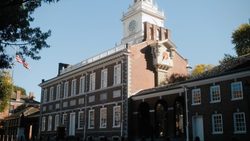
A rebellion of Ulster-Scots farmers in Pelham, Massachusetts, led to the Philadelphia Convention where delegates from the American colonies returned to Independence Hall in 1787 to revise the Articles of Confederation.
Ulster men such as William Paterson and James McHenry influenced the debates over the design of the America's system of government. Once the terms of the American Constitution were agreed, it was William Findley, an Ulster-Scots Covenanting Presbyterian, who argued for a Bill of Rights, the main principles of which still apply today.
Jane Magowan, Series Director, said: "What really surprised me in making the series is that the role played by Ulster-Scots communities and figures in the story of America's fight for independence, in the creation of the Declaration and the Constitution of the United States is more far reaching and impactful than I'd ever imagined.
"Ulster-Scots communities on the frontier and in the cities, their religious leaders, academics, merchants and lawyers not only shaped the movement toward independence, they had a direct influence on the democratic framework of the new Republic."
Declaration, made by DoubleBand Films for BBC Northern Ireland, starts Sunday 28 June at 9pm on BBC Two Northern Ireland and BBC iPlayer.
Episode two will be available to watch on BBC iPlayer from 10pm on Sunday 28 June.